

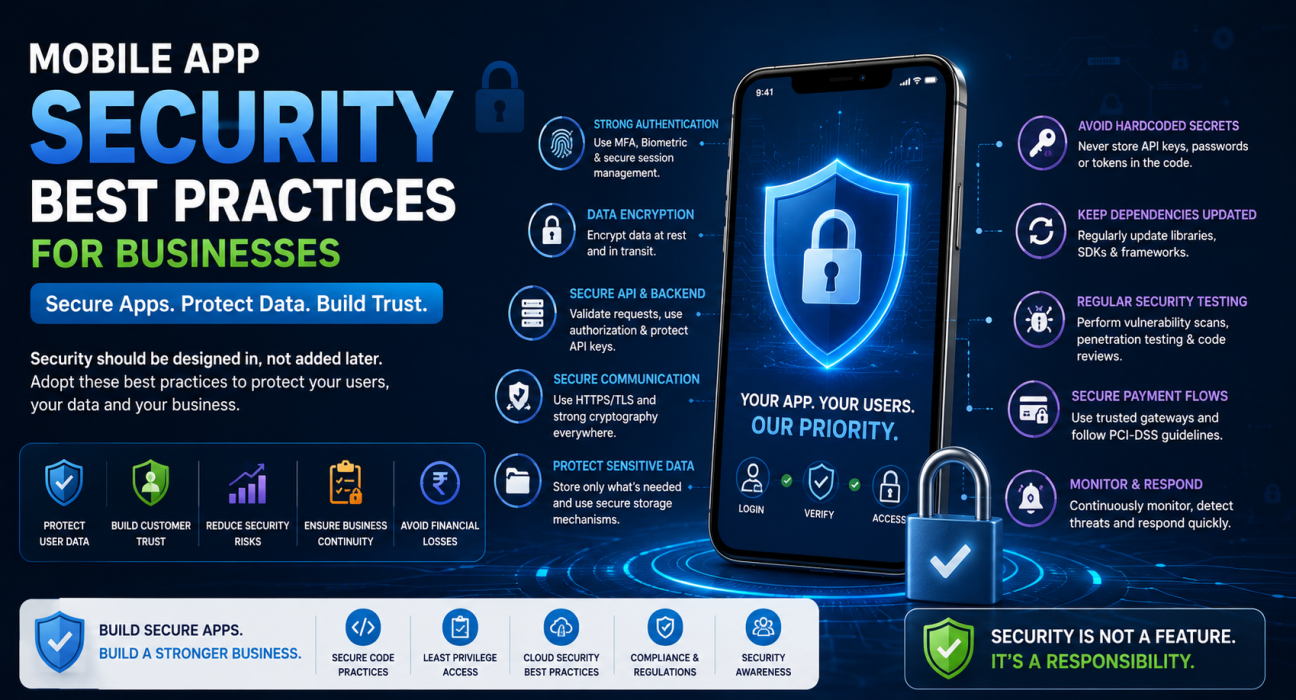
Mobile apps have become part of everyday business in India. Whether a customer is ordering groceries from Velachery, booking a service from OMR, making a UPI payment in T. Nagar, or buying products from an online store in Anna Nagar, mobile apps are handling more personal and financial information than ever before. This makes mobile app security a business priority, not simply a technical concern.
For businesses, a security incident can mean much more than a temporary technical problem. Customer information, passwords, payment details, addresses, order history and business data can all become targets if an application is poorly protected. A good mobile application should therefore be designed with security from the planning stage and maintained throughout its lifecycle.
The OWASP Mobile Application Security Verification Standard (MASVS) provides a useful baseline for mobile security requirements, while the OWASP Mobile Application Security Testing Guide (MASTG) provides guidance for testing mobile applications. Security should be considered from architecture and design through development, testing, deployment and ongoing maintenance.
Why Mobile App Security Matters for Businesses
A mobile app is connected to several moving parts: the smartphone, backend servers, APIs, databases, cloud infrastructure, payment gateways and third-party services. A weakness in any one of these areas can create a security risk.
For an ecommerce business, the risks can be even more serious. An application may store customer profiles, delivery addresses, transaction information, loyalty data and payment-related information. If attackers gain unauthorised access, the business can face financial losses, reputational damage and customer distrust.
That is why mobile app security best practices for businesses should include secure coding, strong authentication, encrypted communication, protected data storage, API security, regular testing and continuous monitoring.
Mobile App Security Best Practices Businesses Should Follow
1. Start With Security During App Planning
Security should not be added after the application is ready. It should be part of the architecture and planning process.
Before development begins, identify what information the app will collect, where it will be stored, who can access it and how it moves between the mobile application and backend systems.
For example, an ecommerce application may need different access levels for customers, delivery staff, vendors and administrators. Defining these roles early can prevent unnecessary access later.
2. Use Strong Authentication
Simple passwords are no longer enough for applications handling sensitive information.
Businesses should consider multi-factor authentication, OTP verification, biometric authentication and secure session management where appropriate. Authentication should also be combined with proper authorisation so that logging into an account does not automatically provide access to information the user should not see.
For example, a customer should not be able to access another customer’s order history simply by manipulating an API request.
3. Protect Sensitive Data
Sensitive information should not be stored carelessly on a mobile device.
Businesses should minimise the amount of sensitive information stored locally and use secure operating-system mechanisms for data that genuinely needs to remain on the device. Encryption should be used for sensitive information both at rest and while it is being transmitted.
OWASP specifically identifies storage and privacy, cryptography, authentication, network communication, platform interaction and code quality as important areas within its mobile application security model.
4. Secure APIs and Backend Systems
The mobile application is only one side of the security equation. Even if the app looks secure, poorly protected APIs can expose the entire system.
Businesses should use secure authentication between the application and backend, validate requests on the server, implement authorisation checks, protect API keys and monitor unusual traffic.
Never assume that validation performed inside the mobile application is enough. Attackers can reverse engineer applications and send requests directly to backend APIs.
5. Use Secure Network Communication
Mobile apps frequently operate on public Wi-Fi, mobile networks and different network conditions. Data travelling between the application and server should therefore be protected using modern secure communication protocols.
OWASP’s baseline mobile security guidance recommends secure defaults and measures such as TLS and strong, up-to-date cryptography.
This is particularly important for ecommerce, fintech, healthcare and other applications where sensitive customer information is exchanged.
6. Avoid Hard-Coded Secrets
API keys, passwords, encryption keys and other sensitive credentials should not simply be written into application code.
Hard-coded secrets can potentially be discovered through reverse engineering. Businesses should use appropriate secret-management mechanisms and rotate credentials when necessary.
The same rule applies to development and production environments: production credentials should never be casually shared among developers or stored in public repositories.
7. Keep Third-Party Libraries Updated
Modern applications depend on frameworks, SDKs, plugins and external services. These dependencies can introduce security vulnerabilities if they are outdated.
Development teams should maintain an inventory of dependencies, monitor security advisories and update vulnerable libraries after appropriate testing.
A clean and regularly maintained technology stack is easier to secure than an application filled with old plugins and unsupported components.
8. Perform Regular Security Testing
Security testing should not happen only before launch.
Businesses should conduct appropriate static analysis, dynamic analysis, penetration testing, API testing and vulnerability assessments depending on the application’s risk profile. OWASP describes mobile app security testing as including evaluation of both the mobile application and the client-server/API architecture it depends on.
For an ecommerce app, testing should cover login, payments, checkout, customer accounts, order information, admin panels and third-party integrations.
9. Build Secure Payment Flows
If an app handles payments, security becomes even more important.
Businesses should avoid unnecessarily storing card information and should work with established payment providers and secure integration methods. Payment flows should also be tested for tampering, replay attacks, authorization issues and incorrect transaction states.
A customer should receive clear confirmation when a payment succeeds or fails, while the backend should remain the final authority on transaction status.
10. Monitor the App After Launch
Security does not end when an app reaches the Play Store or App Store.
Businesses should continuously monitor crashes, suspicious login attempts, unusual API traffic, account takeover patterns and other abnormal activity.
Regular security reviews, dependency updates, penetration testing and incident-response planning help keep the application protected as threats evolve.
Top 10 ECommerce Development Companies in Chennai
Chennai has developed a strong technology ecosystem around OMR, Guindy, Sholinganallur, Thousand Lights and other IT corridors. The companies below were selected because they have a verifiable Chennai presence and relevant experience in ecommerce, mobile applications, software development or digital products.
This is an editorial shortlist rather than a claim that one company is universally better than another. Businesses should still evaluate portfolios, security practices, technical teams and project requirements before making a decision.
1. Ozrit
Company Overview: Ozrit is a full-stack digital solutions company offering mobile app development, application development, ecommerce solutions, AI/ML, UI/UX and other technology services. Its mobile development capabilities include native iOS and Android as well as Flutter and React Native, with a Chennai office on Anna Salai.
Key Points:
- Mobile app development across native and cross-platform technologies
- Experience across ecommerce, fintech, healthcare, logistics and other sectors
- Secure and scalable application architecture
- Backend API and ongoing application support capabilities
- Chennai presence in the Thousand Lights area
Establishment: Founded in 2009.
Team Size: 500+ professionals.
For businesses looking at mobile app security, Ozrit’s combination of application engineering, backend development and security-focused delivery makes it a practical option to evaluate.
2. Pyramidion Solutions
Company Overview: Pyramidion Solutions is a Chennai-based mobile and software development company with experience in iOS, Android, Flutter, React Native and ecommerce application development. Its current website describes more than 11 years of experience and 400+ apps shipped worldwide.
Key Points:
- Native and cross-platform mobile development
- Ecommerce application development
- AI-assisted development and testing
- Secure and scalable application architecture
- Chennai engineering team based in Maduravoyal
Establishment: Public sources place its establishment in the early 2010s; the company currently states 11+ years of experience.
Team Size: 50+ professionals according to industry listings.
3. Hakuna Matata Solutions
Company Overview: Hakuna Matata Solutions is a Chennai-based digital transformation company specialising in enterprise applications, mobile development, cloud and modernisation. Its mobile development practice covers iOS, Android, React Native, Flutter and enterprise workflows.
Key Points:
- Enterprise mobile application development
- Role-based access and backend integration
- Secure architecture and device-management considerations
- Cloud and application modernisation
- Experience with large business workflows
Establishment: 2006.
Team Size: 100+ agile engineering professionals according to its current website; third-party listings place the broader company in the 50-249 range.
4. Smarther Technologies
Company Overview: Smarther Technologies is a Chennai-based mobile app development company working across Android, iOS, Flutter and React Native. It has experience in ecommerce, healthcare, logistics, fintech and other business applications.
Key Points:
- Mobile apps for ecommerce and business applications
- Android, iOS, Flutter and React Native
- Secure and scalable application development
- Payment gateway and third-party integrations
- Post-launch support and maintenance
Establishment: 2011.
Team Size: 50+ engineers, designers and project managers.
5. Team Tweaks Technology
Company Overview: Team Tweaks is a Chennai-based software and mobile application development company offering ecommerce applications, grocery apps, delivery platforms and custom software. Its current website lists an ecommerce app development offering with catalogues, secure checkout, order tracking and scalable administration.
Key Points:
- Ecommerce mobile app development
- Secure checkout and payment features
- Vendor and customer management
- Cloud and cross-platform development
- Agile development and ongoing support
Establishment: 2013 as a private limited company, with operations beginning in 2012.
Team Size: 85+ dedicated professionals according to the company website.
6. Way2Smile Solutions
Company Overview: Way2Smile Solutions is a Chennai-based software development company offering mobile application, web, cloud, AI and data-related services. The company says it has more than 20 years of experience and has delivered 500+ mobile applications.
Key Points:
- Mobile application development
- Enterprise software and SaaS solutions
- UI/UX and digital product development
- Experience across different business sectors
- Long-term application support
Establishment: Around 2010 according to industry listings, with the company currently describing itself as having 20+ years of experience.
Team Size: 100+ skilled developers according to its mobile development page.
7. Muviereck Technologies
Company Overview: Muviereck Technologies is a Chennai-based IT solutions company offering ecommerce development, mobile apps, web development, ERP and CRM solutions. Its Chennai office is located in Aminjikarai.
Key Points:
- Ecommerce website and application development
- Mobile app development
- Secure payment and API integration
- ERP and CRM integration
- Web and digital marketing services
Establishment: 2015.
Team Size: 11- 50 employees according to LinkedIn.
8. W2S Solutions
Company Overview: W2S Solutions provides mobile, web, cloud, AI and data engineering services, with a Chennai location in Sholinganallur. Its technology capabilities include mobile application development, payment gateway integration, cloud deployment and enterprise applications.
Key Points:
- Mobile and web application development
- Payment gateway integration
- Cloud and data engineering
- Enterprise digital solutions
- Chennai presence at Rattha Tek Meadows
Establishment: 2010 according to LinkedIn.
Team Size: 51–200 employees.
9. Colan Infotech
Company Overview: Colan Infotech is a Chennai-headquartered technology company offering software, mobile, web, AI and ecommerce development services. Its ecommerce practice includes B2B, B2C and D2C applications, secure payment integrations and mobile commerce solutions.
Key Points:
- Ecommerce application development
- Mobile commerce solutions
- Secure payment integration
- CRM, ERP and third-party integrations
- Agile development and scalable architecture
Establishment: 2009.
Team Size: 600+ developers according to the company’s current website.
10. SivaCerulean Technologies
Company Overview: SivaCerulean Technologies is a Chennai-based software and mobile application development firm with operations in India and the USA. Its services include mobile apps, web applications, custom software, QA automation and digital solutions, with retail and ecommerce listed among its focus areas.
Key Points:
- Mobile and web application development
- Retail and ecommerce software
- QA and test automation
- Cloud, AI and other modern technologies
- Chennai presence on OMR
Establishment: 2018.
Team Size: 11- 50 employees according to LinkedIn.
Factors and Criteria We Considered to Rank These Companies
We did not simply pick names from a Google search and call it a day. For a useful Top 10 ECommerce Development Companies in Chennai list, we considered a combination of business, technical and local factors.
- Verified Chennai presence: Companies needed a genuine Chennai office or operational presence.
- Ecommerce and mobile expertise: Preference was given to companies with demonstrable experience in ecommerce applications, mobile commerce or related digital products.
- Mobile app security awareness: Security-related capabilities, secure payment integration, QA, API protection and scalable architecture were considered where publicly documented.
- Years of establishment: Companies with an established operating history were given preference over very new agencies with limited track records.
- Team strength: We considered publicly available information about engineering and delivery teams.
- Technology capability: Experience with native Android/iOS, Flutter, React Native, cloud infrastructure, APIs and modern backend technologies was considered.
- Security and testing: QA, testing, secure development practices and application maintenance were treated as important factors because security cannot stop at launch.
- Portfolio and industry exposure: Experience across ecommerce, fintech, healthcare, logistics, retail and other demanding sectors was considered useful.
- Scalability: Businesses need applications that can handle growth from a few hundred users to much larger customer bases without becoming a bottleneck.
- Communication and delivery: Agile development, project transparency and post-launch support were considered valuable for long-term projects.
- Business suitability: We favoured established small and mid-sized technology companies rather than automatically choosing huge multinational IT corporations.
- Value for businesses: A good technology partner should balance engineering quality, security, scalability, support and budget.
Conclusion
Mobile app security is no longer something businesses can treat as a technical item on a checklist. From the first wireframe to the production release, security needs to be built into the application architecture, code, APIs, data storage, authentication, payment flows and monitoring processes.
For ecommerce businesses especially, customer trust is everything. A smooth checkout may bring a customer to your app, but secure transactions and responsible data handling are what encourage them to return. Whether your customers are shopping from T. Nagar, browsing during the evening traffic on OMR, or placing an order from a smaller town, they expect the same thing: a fast, reliable and secure experience.
Chennai has a strong pool of technology companies that can support businesses across ecommerce development, mobile applications, cloud services and digital transformation. The companies covered above represent different team sizes, technology strengths and delivery models, so the right choice ultimately depends on your application’s requirements.
Before signing a development agreement, ask practical questions about secure coding, API protection, authentication, encryption, penetration testing, dependency management, incident response and post-launch monitoring. Do not hesitate to request examples of how the development team has handled security in previous projects.
In the end, good mobile app security is much like a strong foundation for a Chennai home: customers may not see it every day, but they certainly notice when it is missing. Build security into the product from day one, keep testing as the application grows, and choose a development partner that treats security as part of the product-not as an afterthought.